Tesla App – Elvee blog

Tesla Battery Percentage vs Rated Range

How Tesla battery percentage and rated range differ, and when each display mode is more useful for owners.

Elvee for Tesla Editorial Team2026-05-069 min read
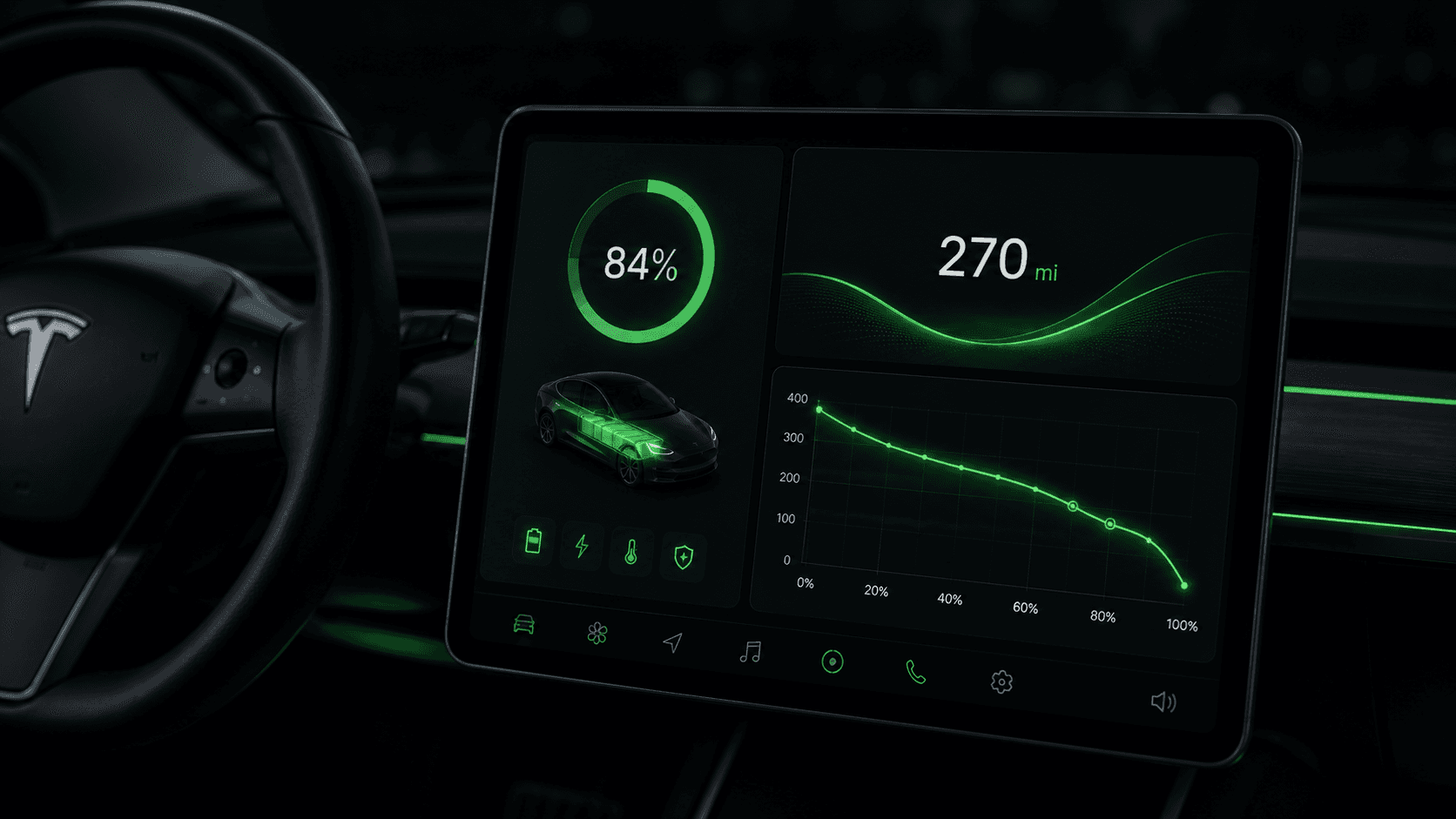
Minimal premium Tesla cockpit scene showing percentage and rated range concepts through clean floating interface elements.

Table of contents

What battery percentage and rated range actually mean

Battery percentage tells you how full the battery is relative to its current usable capacity. Rated range turns that into an estimated distance based on a standardized efficiency assumption.

Both are useful, but they serve different mental models. Percentage is simple and stable. Rated range is more intuitive for people thinking in distance, but it can also trigger more anxiety when the number changes.

When percentage is the better display

Percentage is often better for everyday ownership because it behaves like a fuel gauge. It is less affected by how owners emotionally react to every mile estimate.

  • Good for daily commuting
  • Useful when your routes are familiar
  • Reduces overreaction to small display swings
  • Makes charge targets easier to think about

When rated range is more useful

Rated range can help with trip planning because distance is easier to visualize than a percentage number. It becomes especially useful when owners are trying to understand whether a drive is comfortably within reach.

The limitation is that rated range is still an estimate. Weather, speed, elevation, and driving style can make real-world results differ from what the display suggests.

Why owners get confused between the two

A lot of confusion comes from treating rated range like a promise rather than an estimate. Owners see a lower number than expected and assume the battery has degraded or the car is behaving badly, when the real issue may be expectation.

Practical example

An owner might feel calm at 70 percent charge but anxious at a lower-than-expected mile estimate, even though both displays are describing the same battery state from different angles.

Tip

Use percentage for your normal routine and switch your thinking to route planning when you need to translate that into distance.

Common mistakes with Tesla battery displays

The display you choose should reduce stress and improve judgment. If it is doing the opposite, the issue may be the interpretation rather than the car.

Common mistakes

  • - Treating rated range like a guaranteed outcome
  • - Assuming a temporary range estimate change means battery damage
  • - Switching between display modes constantly and comparing them emotionally
  • - Ignoring conditions such as weather and speed during trip planning

FAQ

Is Tesla battery percentage more accurate than rated range?

They measure different things. Percentage is usually simpler for daily use because it shows state of charge directly, while rated range translates that into estimated distance.

Should I use percentage or miles on my Tesla?

Many owners prefer percentage for everyday driving and use route planning tools or context-based thinking when distance matters more.

Why does my rated range change even if nothing is wrong?

Rated range can look different because of calibration, conditions, and estimate assumptions. It does not always mean the battery has degraded.

Conclusion

Tesla battery percentage and rated range are both useful, but they are useful in different ways.

Owners who treat percentage as the daily baseline and rated range as planning context usually end up with a calmer and clearer ownership experience.

Suggested internal links

Suggested external references

CTA

Need clearer Tesla battery and charging insight?

Tesla App - Elvee helps owners track charging, battery trends, and daily vehicle analytics without turning every metric into noise.