Tesla App – Elvee blog

Tesla Battery Health Myths

Common Tesla battery health myths explained, with a calmer look at what actually affects battery condition over time.

Elvee for Tesla Editorial Team2026-04-088 min read
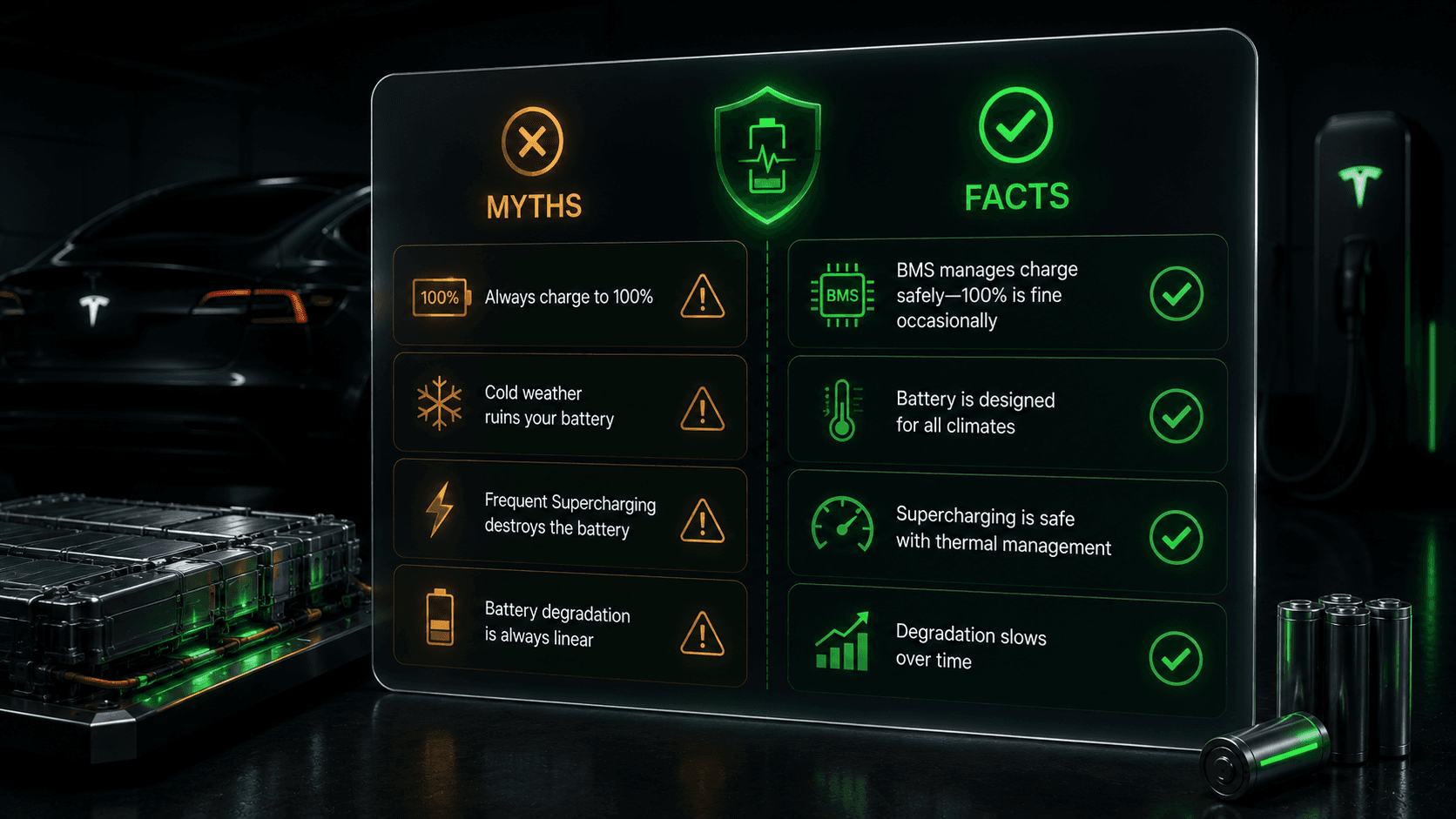
Premium EV battery with futuristic floating myth and fact cards in a dark studio scene.

Table of contents

Why Tesla battery myths spread so fast

Battery topics are emotional because range and charging feel directly tied to daily convenience. That makes owners more likely to repeat dramatic advice, even when it is oversimplified or missing context.

The internet is especially good at turning edge cases into universal warnings. A single owner experience can sound like a rule when it is really just one situation with its own conditions.

Two of the most common myths

Myth: every small range drop means permanent degradation

Range estimates move for many reasons, including temperature, calibration, driving conditions, and battery state. A short-term change is not automatically permanent battery loss.

Myth: the battery must always be charged as high as possible

That approach is often unnecessary for normal daily ownership. Many owners benefit more from a sensible routine that matches actual use rather than always aiming higher out of habit.

Two more myths that confuse owners

Myth: fast charging always destroys Tesla batteries

Fast charging is a normal part of EV ownership, especially on trips. The key is how it fits into overall usage, not panic around every use of it.

Myth: battery health can be judged perfectly from one number

Battery health is best understood as a trend. Owners usually get a better picture by combining charging behavior, long-term range context, and analytics over time.

A better way to think about Tesla battery health

The best approach is calm, consistent observation. Use longer comparison windows, understand your charging routine, and separate normal variation from genuine long-term change.

Most owners do not need more fear. They need better context.

Tip

If a battery claim sounds absolute, it is usually missing an important detail.

Common mistakes that myths create

Battery myths do not just create confusion. They often lead owners into worse routines built around fear instead of useful evidence.

Common mistakes

  • - Changing a good routine because of one alarming forum post
  • - Comparing your car to another owner's car with different usage
  • - Checking data too often without using a consistent frame of reference

FAQ

Is every Tesla range drop a sign of battery damage?

No. Short-term range changes can happen because of weather, calibration, or driving conditions. Long-term trend analysis is more useful than reacting to one reading.

Does fast charging always hurt Tesla battery health?

Fast charging is a normal part of Tesla ownership. It is best understood as one part of the broader charging pattern rather than a simple good-or-bad rule.

What is the best way to avoid Tesla battery myths?

Use consistent trend tracking, follow vehicle-appropriate charging guidance, and be cautious of blanket advice that ignores context.

Conclusion

Tesla battery myths are persuasive because they simplify a topic that is actually shaped by context, chemistry, routine, and time.

Owners who rely on trend-based information usually make better decisions than owners who rely on dramatic one-line rules.

Suggested internal links

Suggested external references

CTA

Need clearer Tesla battery and charging insight?

Tesla App - Elvee helps owners track charging, battery trends, and daily vehicle analytics without turning every metric into noise.