Tesla App – Elvee blog

How Regenerative Braking Works

A beginner-friendly explanation of Tesla regenerative braking, what it does, and how it affects efficiency and daily driving feel.

Elvee for Tesla Editorial Team2026-04-128 min read
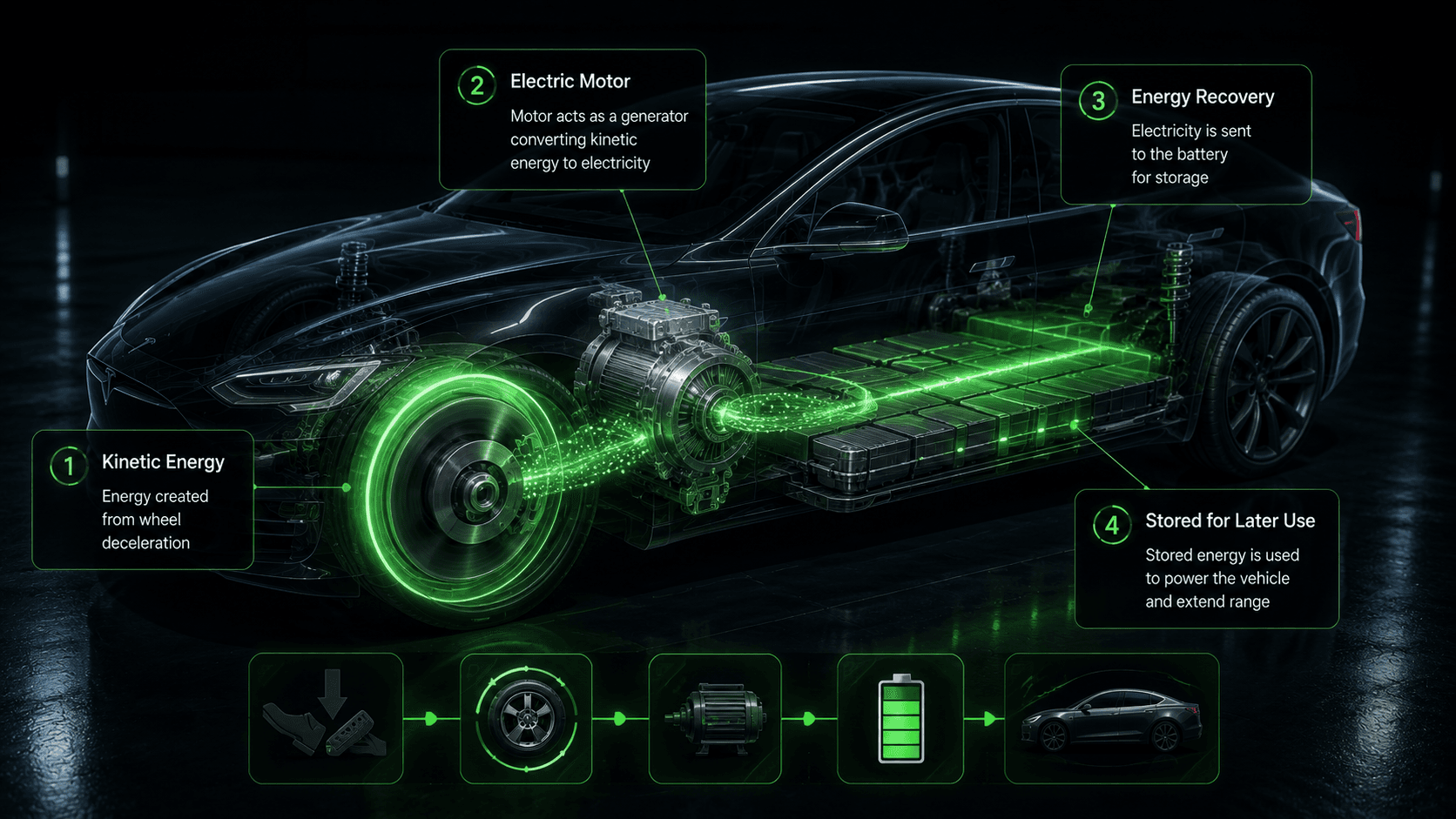
Energy flowing from Tesla wheels back into the battery in a premium futuristic technical visualization.

Table of contents

What regenerative braking actually is

Regenerative braking is the process of turning some of the car's motion back into electrical energy when you slow down. Instead of wasting all that energy as heat the way traditional braking often does, the vehicle can recover part of it and send it back to the battery.

For Tesla owners, this is one of the most noticeable differences in EV driving because it changes how the car feels when you lift off the accelerator.

What it feels like while driving

Many owners first notice regenerative braking as stronger deceleration when lifting off the accelerator. That is why people often describe Tesla driving as more compatible with one-pedal driving habits.

Once drivers adjust, regen often makes the car feel smoother and more controlled in everyday traffic.

Practical example

Approaching a slower section of road, a Tesla owner may simply ease off the accelerator earlier than they would in a traditional car. The vehicle begins slowing while also recovering energy.

Why regenerative braking matters for efficiency

Regenerative braking helps because it recovers part of the energy that would otherwise be lost during deceleration. That recovered energy contributes to overall efficiency and can slightly improve how effectively the battery is used over normal driving.

It is not magic, and it does not erase all energy loss, but it is one of the important reasons EVs feel efficient in urban and mixed driving.

Its limits and the misunderstandings owners often have

Regen is useful, but it does not replace every form of braking or recover every bit of energy. It is one part of the system, not the whole story.

Common mistakes

  • - Assuming regenerative braking makes physical brakes irrelevant
  • - Expecting the same regen feel in all weather and battery conditions
  • - Believing all lost driving energy can be recovered

Where analytics help owners understand the effect

Owners who want to understand efficiency over time often benefit from looking at energy and trip patterns rather than just trusting feel alone.

That is where an analytics app becomes useful. It helps connect driving behavior, charging, and energy results into one clearer ownership picture.

FAQ

What is regenerative braking in a Tesla?

Regenerative braking recovers some energy during deceleration and sends it back to the battery, improving efficiency and changing how the car slows down.

Does regenerative braking replace normal brakes?

No. Regenerative braking helps slow the car and recover energy, but the standard braking system still matters for many driving situations.

Why does Tesla driving feel different when I lift off the accelerator?

That feeling often comes from regenerative braking, which causes stronger deceleration than many drivers expect at first.

Conclusion

Regenerative braking is one of the most useful and distinctive parts of Tesla driving because it improves efficiency while changing the feel of everyday deceleration.

Once owners understand what it is doing, they usually drive more smoothly and interpret energy use more clearly.

Suggested internal links

Suggested external references

CTA

Need clearer Tesla battery and charging insight?

Tesla App - Elvee helps owners track charging, battery trends, and daily vehicle analytics without turning every metric into noise.